


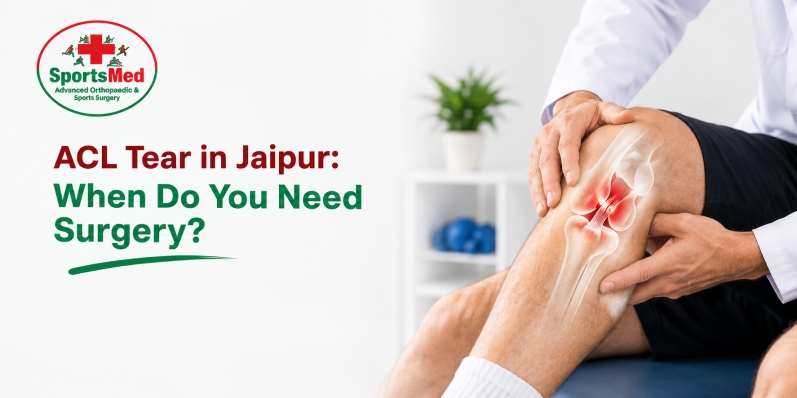
ACL Tear in Jaipur: When Do You Need Surgery?
An ACL tear can change the way you walk, run, climb stairs, or play your favourite sport. But an important question often comes after the diagnosis: Does every ACL tear require surgery?
The answer is no. The need for surgery depends on several factors, including the severity of the tear, knee stability, activity level, associated injuries, and your recovery goals.
For someone searching for ACL Tear in Jaipur, getting the right diagnosis is the first step. At Sports Injury Care, Dr. Vikram Sharma and the sports medicine team focus on detailed clinical evaluation, imaging, treatment planning, and rehabilitation for sports and knee ligament injuries.
What Is an ACL Tear?
The anterior cruciate ligament, commonly called the ACL, is one of the major stabilising ligaments inside the knee. It helps control forward movement and rotational stability of the knee.
An ACL injury can occur during:
-
Sudden changes in direction
-
Pivoting or twisting
-
Incorrect landing after a jump
-
Contact sports
-
Falls or accidents
-
Sports involving rapid acceleration and deceleration
Common symptoms include swelling, pain, a feeling that the knee is giving way, difficulty changing direction, and reduced confidence while putting weight on the affected leg.
Does Every ACL Tear Need Surgery?
Not necessarily.
A partial ACL injury or a complete tear in a person with lower physical demands may sometimes be managed without surgery. Non-surgical treatment can include physiotherapy, activity modification, bracing when appropriate, and pain management.
However, surgery may be considered when the knee remains unstable, the person wants to return to sports involving pivoting, or there are additional injuries within the knee.
The decision should be based on an individual assessment rather than the MRI report alone. Sports Injury Care's treatment information also notes that treatment varies according to the extent of the injury and the patient's individual needs.
When Is ACL Surgery Usually Considered?
1. Your Knee Keeps Giving Way
Repeated episodes of knee instability are an important reason to discuss surgery with an ACL specialist.
If the knee repeatedly buckles during walking, turning, climbing stairs, or sports, everyday movement can become difficult. Continued instability may also increase the risk of additional knee problems.
2. You Want to Return to Pivoting Sports
Athletes involved in sports such as football, basketball, cricket, badminton, or similar activities place significant demands on knee stability.
If your goal is to return to competitive or high-level sports, an ACL specialist may recommend reconstruction depending on your injury and functional assessment.
3. There Are Additional Knee Injuries
An ACL tear may occur alongside other injuries, such as:
-
Meniscus tears
-
Cartilage injuries
-
Other ligament injuries
-
Bone bruising
When multiple structures are involved, the overall treatment plan can become more complex. MRI and clinical examination help assess the extent of the injury.
4. Physiotherapy Has Not Provided Enough Stability
Some patients initially undergo structured rehabilitation without surgery. If appropriate rehabilitation has been completed but the knee continues to feel unstable or cannot meet the person's activity requirements, surgical treatment may be discussed.
When Can ACL Treatment Without Surgery Be Considered?
Non-surgical treatment may be appropriate in selected patients, particularly when:
-
The tear is partial, or the knee remains functionally stable
-
The person has lower physical demands
-
There is no significant associated knee injury
-
Symptoms are manageable
-
The patient does not need to return to pivoting or competitive sports
-
Strength and knee function improve with rehabilitation
This does not mean that avoiding surgery is automatically the right choice. A sports medicine specialist can assess whether the knee is stable enough for your daily and recreational activities.
How Is an ACL Tear Diagnosed?
A proper diagnosis generally starts with your medical history and physical examination.
Your doctor may perform specific clinical tests to assess knee stability. X-rays can help identify bone-related problems, while MRI is useful for evaluating the ACL and other soft-tissue structures. Sports Injury Care's ACL information specifically describes clinical examination, X-rays, and MRI as part of the diagnostic process.
Why Clinical Examination Matters
An MRI can show the structural injury, but treatment decisions also depend on how your knee functions.
Two people can have similar MRI findings but require different treatment plans because their:
-
Age
-
Activity level
-
Knee stability
-
Sports requirements
-
Associated injuries
-
Recovery goals
may be different.
What Happens If ACL Surgery Is Recommended?
ACL reconstruction is generally a planned procedure rather than an emergency operation. Before surgery, the knee may need to regain as much movement and control as possible.
This preparation is sometimes called prehabilitation.
It may involve:
-
Reducing swelling
-
Improving knee movement
-
Strengthening the surrounding muscles
-
Improving walking mechanics
-
Preparing for post-operative rehabilitation
Sports Injury Care describes ACL reconstruction as an elective procedure in which preoperative preparation and rehabilitation planning are important parts of the process.
What Is ACL Reconstruction?
During ACL reconstruction, the damaged ligament is replaced using a suitable tendon graft. Arthroscopic techniques use small incisions and a camera to allow the surgeon to work inside the knee.
The exact technique and graft choice depend on the patient's anatomy, injury, activity requirements, and other clinical considerations. Sports Injury Care describes several ACL reconstruction approaches and emphasises customised treatment rather than a single technique for every patient.
Choosing an ACL Specialist in Jaipur
Choosing the right specialist is an important part of ACL care. Look for a doctor who evaluates the complete injury rather than focusing only on the MRI report.
At Sports Injury Care, Dr. Vikram Sharma is listed as Head of SportsMed and Consultant Arthroscopic Surgeon & Sports Medicine Specialist. The centre's website also lists his training in sports medicine and arthroscopy, including fellowship training at the University of Pittsburgh, along with sports medicine roles associated with organisations including the Rajasthan Cricket Association and BCCI.
For patients searching for the best ACL surgeon in Jaipur, it is useful to consider experience, sports medicine expertise, diagnostic approach, surgical options, and rehabilitation support rather than choosing a surgeon based on a single factor.
If you are looking for an ACL tear specialist in Jaipur, Sports Injury Care provides evaluation and treatment planning for ACL and other sports-related knee injuries.
ACL Tear Treatment in Jaipur: What Should You Do Next?
If you suspect an ACL injury, don't try to decide about surgery based on pain alone.
A proper evaluation can help determine:
-
Whether the ACL is partially or completely torn
-
Whether the knee is clinically unstable
-
Whether the meniscus or cartilage is also injured
-
Whether physiotherapy could be appropriate
-
Whether reconstruction should be considered
-
What rehabilitation would involve
The right treatment is the one that matches your knee condition, lifestyle, and functional goals.
Frequently Asked Questions About ACL Tear
Can an ACL tear heal without surgery?
Some ACL injuries can be managed without surgery through rehabilitation, particularly when the knee remains stable and activity demands are lower. The decision should be individualised.
How do I know if I need ACL surgery?
Persistent knee instability, repeated giving-way episodes, associated injuries, and the need to return to pivoting sports are factors that may support considering surgery.
Is MRI necessary for an ACL tear?
MRI can help confirm the ACL injury and identify associated damage to structures such as the meniscus and cartilage. A clinical examination is also important.
How long does ACL surgery recovery take?
Recovery varies from person to person and depends on the procedure, associated injuries, rehabilitation, and individual goals. Returning to sports usually requires a structured rehabilitation programme rather than simply waiting for the surgical wound to heal.
Who treats ACL tears in Jaipur?
ACL tears are commonly evaluated by orthopaedic and sports medicine specialists. At Sports Injury Care, Dr. Vikram Sharma provides sports medicine and arthroscopic care for ACL and other knee ligament injuries.
Can I walk with a torn ACL?
Some people can walk after an ACL tear, while others experience significant pain, swelling, or instability. Being able to walk does not necessarily mean the knee has recovered.
Conclusion
An ACL tear does not automatically mean you need surgery. The decision depends on knee stability, the extent of injury, associated damage, activity requirements, and your rehabilitation goals.
If you have persistent instability, difficulty returning to your usual activities, or an MRI-confirmed ACL injury, a specialist assessment can help you understand your options.
For ACL Tear in Jaipur, ACL tear treatment in Jaipur, or consultation with an ACL tear specialist in Jaipur, Sports Injury Care offers sports medicine, arthroscopic evaluation, treatment planning, and rehabilitation support under Dr. Vikram Sharma.